

How Much Money Does An Rn Make Per Year
Salaries of registered nurses in the US are among the best in the world. But how much do nurses make? Here you'll find the answer to this question together with many more insights about nurse salaries. We take a look at the average nurse salary and also registered nurse salaries by state for 2020-2021. We then highlight a number of other factors that influence the salary you can expect to earn. Or that can affect your decision about where to study and where to apply for a job.
This nurse salary guide serves to give you an outlook on what the data says about nurse salaries and how you can negotiate for better pay and grow your nursing career!
What's new for this year?
What were the most notable changes in nurses' salaries since the last BLS survey?
The average salary growth for registered nurses was 3.29%, which was the highest annual increase since 2008. There were, however, considerable differences in the average salary growth between states. For example, registered nurse salaries in California increased by 5.8%, while in Delaware it was only 0.3%.
Based on data provided by Payscale.com, the difference between the salaries of nurses with an associate degree and BSN qualified nurses increased by 1.4%.
The growth in salaries for LPN's (3.17%) and advanced nurse practitioners (3.2%) was similar to that of registered nurses. The average salaries of nurse anesthetists, however, increased by 4.2%. Interestingly, the national average wage increased by 5%, higher than that for nurses. On the other hand, the gap between average registered nurse salaries and salaries of all health workers became slightly smaller, as the average income of everyone in the health sector only grew by 2.6%.
What is the Average Nurse Salary?
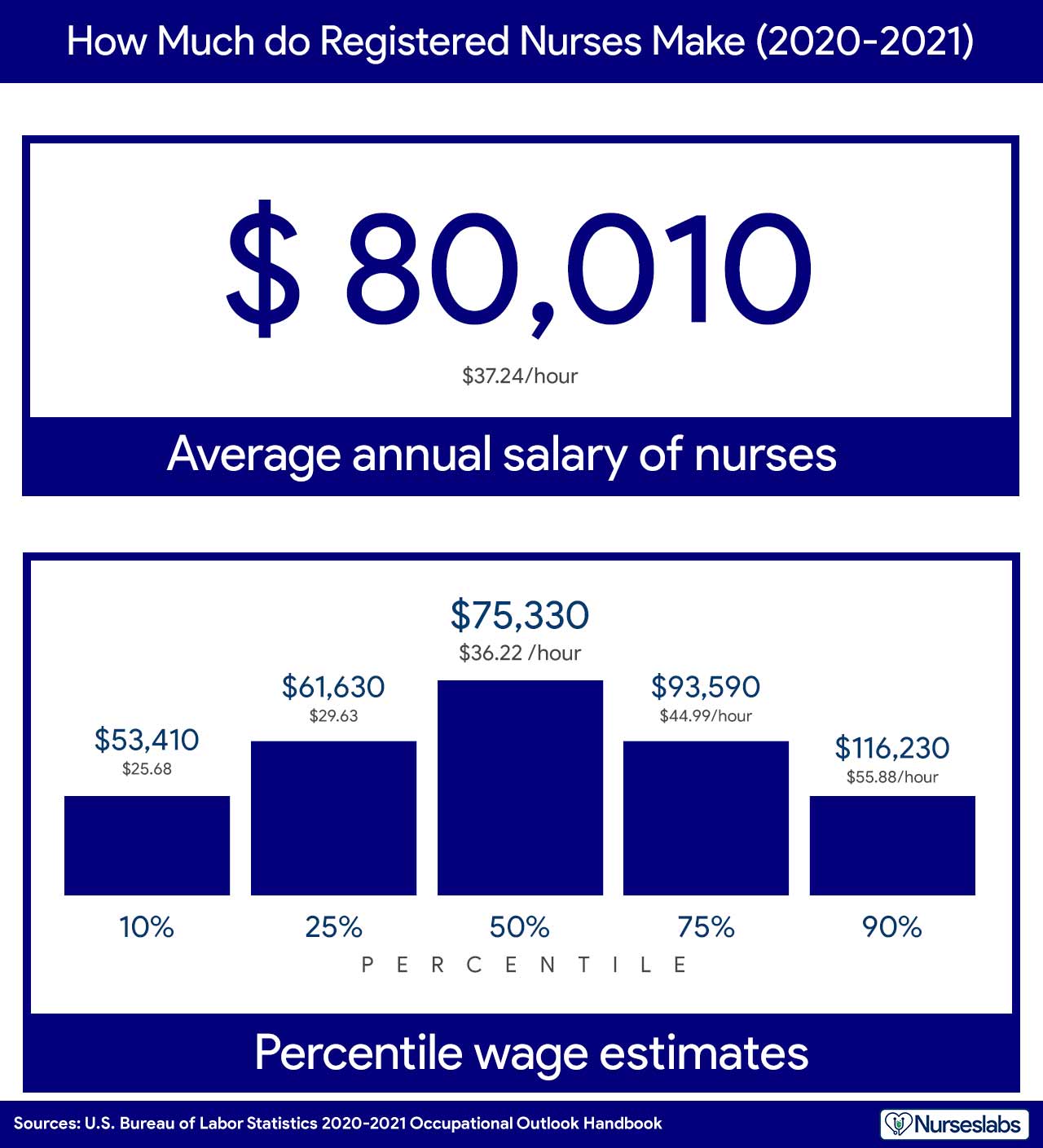
The average annual salary of a registered nurse for 2021 is at $80,010. How does yours compare? Learn more about nurse salaries here: https://nurseslabs.com/nurse-salary/ Click to Tweet
The national average salary of a registered nurse according to the most recent data is $80,010 per year, representing an hourly wage of $38.47. This is according to the estimates released by the United States Bureau of Labor Statistics (BLS) Occupational Outlook Handbook in March 2021.
There was an increase in the average hourly wage of over one dollar between 2019 and 2020. The average annual salary of the 10% of RN's who earned the least was $53,410, and the top 10% earned an average of $116,230.
Salary Growth of Registered Nurses
On average, the salary of registered nurses grew by 1.66% per year in the decade 2011 to 2020 according to data by the BLS. The data collected in 2020 showed an above average growth of 3.29%, which might be linked to the countrywide shortage of nurses during the COVID-19 epidemic. Nurse salaries are expected to continue increasing steadily as the demand for nurses grows.

Factors that are expected to drive growth include higher demand for preventive care, retirement of the baby boomer generation, access to better medical technology, and expanded health coverage for more Americans.
| YEAR | PER HOUR | SALARY | GROWTH | %GROWTH |
|---|---|---|---|---|
| 2011 | $33.23 | $69,118 | $1,394 | 2.02% |
| 2012 | $33.13 | $68,910 | -$208 | -0.30% |
| 2013 | $34.20 | $71,136 | $2,226 | 3.13% |
| 2014 | $33.55 | $69,784 | -$1,352 | -1.94% |
| 2015 | $34.14 | $71,011 | $1,227 | 1.73% |
| 2016 | $34.70 | $72,176 | $1,165 | 1.61% |
| 2017 | $35.36 | $73,549 | $1,373 | 1.87% |
| 2018 | $36.30 | $75,504 | $1,955 | 2.59% |
| 2019 | $37.24 | $77,460 | $1,956 | 2.59% |
| 2020 | $38.47 | $80,010 | $2,550 | 3.29% |
| AVERAGE | $34.81 | $72,399 | $1,225 | %1.67 |
Nurse Salary Compared
The average salaries earned by registered nurses compare very well with the overall US national salary average of $56,310 per year or $25.72 per hour. However, registered nurses earn slightly less than the average for everyone in the health sector which was estimated at $85,900 per year, with an hourly average of $41.30.
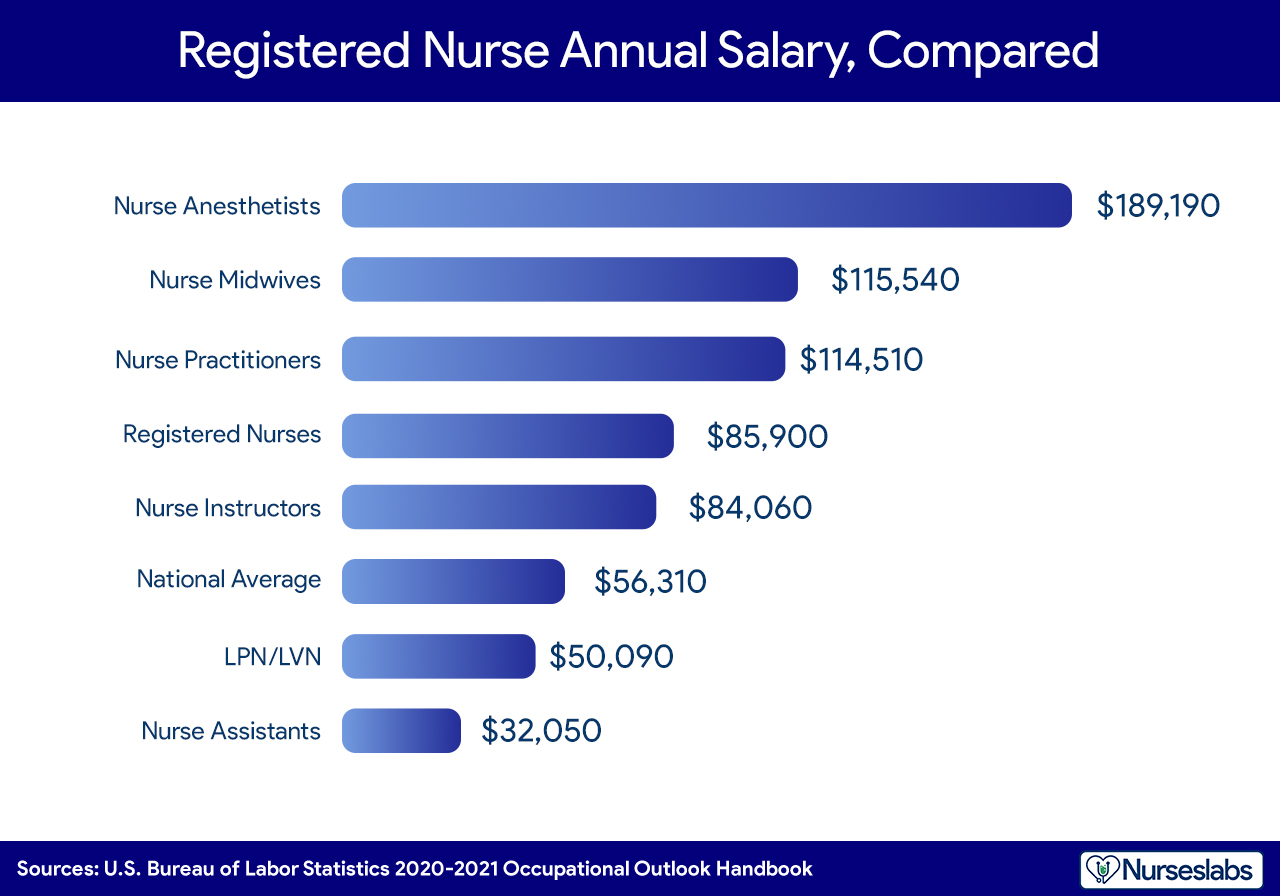
In comparison, licensed practical or vocational nurses (LPN/LVN) earned an average of $50,090 per year or $24.08 per hour. Meanwhile, nursing assistants' average salary is $32,050 per year.
Nurse practitioners (NP) (excluding nurse anesthetists) earn on average $114,510 per year or $55.05 per hour. NPs are RNs with specialized education that diagnose and treat acute, episodic, or chronic illness, independently or as part of a healthcare team. The top 10% of nurse practitioners earn $156,160.
Nurse instructors, who demonstrate and teach nursing science in classrooms and clinical units to nursing students, earn an average salary of $84,060 per year.
The figures for nurse-midwife salaries were not available for 14 states so the numbers included in the estimates are not fully representative. Average annual salaries of nurse-midwives are at $115,540, or $55.55 per hour. This puts their earnings slightly above that of the other advanced practice registered nurses.
Certified Registered Nurse Anesthetists (CRNA) remain the highest paid nurses at an average annual salary of $189,190, or $87.04 per hour. CRNAs earn in a range of $133,970 (lowest 10%) to $208,000 (top 10%). If you are interested in becoming a CRNA, please read our guide Certified Registered Nurse Anesthetist: How To Become a CRNA.
***Keep in mind that the discussion below refers only to registered nurses and does not include nurses with advanced qualifications.
Nurse Salaries by State
What are the best paying states for nurses? According to the latest BLS data, the top five highest paying states for registered nurses are: California, Hawaii, Massachusetts, Oregon and Alaska.
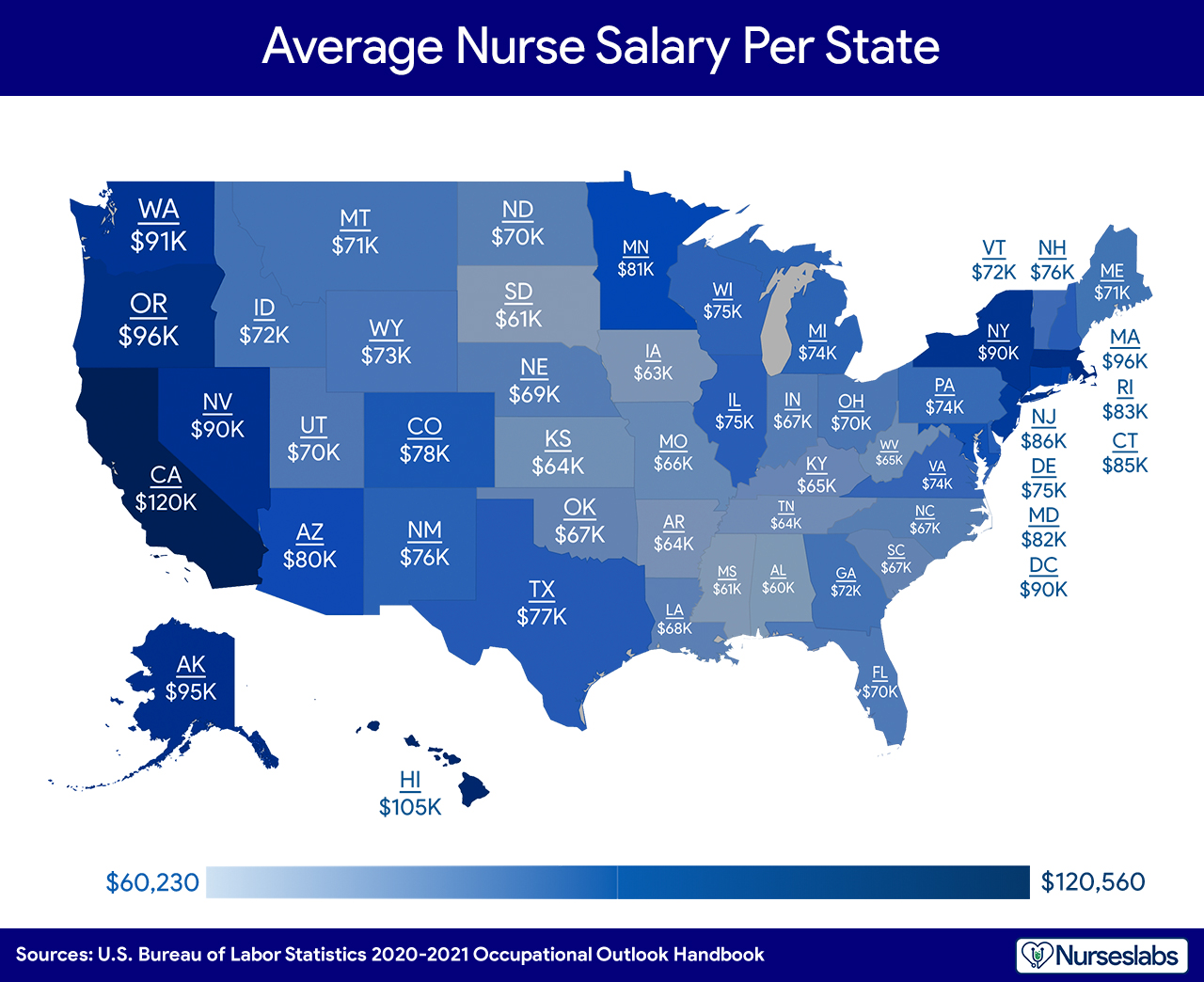
The table below provides details on the total number of employed registered nurses in each state, their average annual nurse salaries, and the average hourly wage. Not all nurses earn the same. As you can see in the table, the state in which a nurse works has a big influence on the salary they'll earn. When considering your potential salary, it's also very important to keep in mind the cost of living in a particular state – in other words, the actual buying power of each dollar you earn. To allow for easy comparison, we have provided the relative purchasing power (RPP) for each state. This figure is a percentage of the cost of living in each state compared to national price levels. In terms of the RPP, you can do the same with a salary of $55,000 in Massachusetts (RPP 110.4) as with a salary of $45,000 in Tennessee (RPP 89.7).
| STATE | #RNs | ANNUAL | HOURLY | RPP |
|---|---|---|---|---|
| Alabama | 48,850 | $60,230 | $28.96 | 85.8 |
| Alaska | 6,240 | $95,270 | $45.81 | 105.1 |
| Arizona | 55,520 | $80,380 | $38.64 | 95.3 |
| Arkansas | 25,300 | $63,640 | $30.60 | 84.7 |
| California | 307,060 | $120,560 | $57.96 | 116.4 |
| Colorado | 52,330 | $77,860 | $37.43 | 101.9 |
| Connecticut | 33,400 | $84,850 | $40.79 | 105 |
| Delaware | 11,410 | $74,330 | $35.74 | 101 |
| District of Columbia | 10,320 | $90,050 | $43.29 | 115.2 |
| Florida | 183,130 | $69,510 | $33.42 | 101 |
| Georgia | 73,230 | $71,510 | $34.38 | 93.2 |
| Hawaii | 11,260 | $104,830 | $50.40 | 119.3 |
| Idaho | 12,800 | $71,640 | $34.44 | 92.2 |
| Illinois | 127,450 | $74,560 | $35.85 | 97.4 |
| Indiana | 66,460 | $67,490 | $32.45 | 88.7 |
| Iowa | 32,610 | $62,570 | $30.08 | 89 |
| Kansas | 29,430 | $64,200 | $30.87 | 89.2 |
| Kentucky | 42,940 | $64,730 | $31.12 | 87.4 |
| Louisiana | 41,690 | $68,010 | $32.70 | 87.9 |
| Maine | 14,160 | $71,040 | $34.16 | 99.3 |
| Maryland | 51,480 | $81,590 | $39.23 | 107.7 |
| Massachusetts | 84,030 | $96,250 | $46.27 | 110.4 |
| Michigan | 97,820 | $73,980 | $35.57 | 92.3 |
| Minnesota | 70,820 | $80,960 | $38.92 | 98 |
| Mississippi | 28,800 | $61,250 | $29.45 | 84.4 |
| Missouri | 71,560 | $65,900 | $31.68 | 88.7 |
| Montana | 9,980 | $70,530 | $33.91 | 93.5 |
| Nebraska | 24,060 | $69,480 | $33.41 | 89.5 |
| Nevada | 23,420 | $89,750 | $43.15 | 97.4 |
| New Hampshire | 13,840 | $75,970 | $36.52 | 106.5 |
| New Jersey | 78,590 | $85,720 | $41.21 | 116 |
| New Mexico | 17,100 | $75,700 | $36.40 | 91.1 |
| New York | 178,550 | $89,760 | $43.16 | 116.3 |
| North Carolina | 99,110 | $68,950 | $33.15 | 91.7 |
| North Dakota | 9,970 | $69,630 | $33.47 | 89.3 |
| Ohio | 129,090 | $69,750 | $33.53 | 88.4 |
| Oklahoma | 32,950 | $66,600 | $32.02 | 87.2 |
| Oregon | 36,840 | $96,230 | $46.27 | 102.2 |
| Pennsylvania | 146,640 | $74,170 | $35.66 | 97 |
| Rhode Island | 12,150 | $82,790 | $39.81 | 101.3 |
| South Carolina | 45,930 | $67,140 | $32.28 | 91.5 |
| South Dakota | 13,130 | $60,960 | $29.31 | 87.8 |
| Tennessee | 61,040 | $64,120 | $30.83 | 89.7 |
| Texas | 219,330 | $76,800 | $36.92 | 96.5 |
| Utah | 23,690 | $70,370 | $33.83 | 96.5 |
| Vermont | 6,810 | $72,140 | $34.68 | 103.1 |
| Virginia | 66,450 | $74,380 | $35.76 | 101.3 |
| Washington | 59,300 | $91,310 | $43.90 | 108.4 |
| West Virginia | 19,800 | $65,130 | $31.31 | 87.1 |
| Wisconsin | 63,630 | $74,760 | $35.94 | 91.9 |
| Wyoming | 5,010 | $72,600 | $34.90 | 92.8 |
Salaries also differ considerably between metropolitan and rural areas – the cost of living and nurses' salaries are generally much higher in the cities. This is mainly because housing costs a lot more. The large populations in cities create a greater demand for housing and this drives prices up.
Salaries by Employer
Registered nurse salaries differ quite a bit depending on where and by whom they are employed. Of the 2,986,500 registered nurses included in the BLS survey, the single largest group is employed in general medical and surgical hospitals (31%) with an average salary of $81,680. Registered nurses employed in outpatient care centers earn more than those working in hospitals at an average of $89,300. Registered nurses working in offices of physicians, residential care services, and in school or college health services earn well below-average salaries. Nurses in school or college health services earn an average of $69,180.
| INDUSTRY | #EMPLOYED | % | HOURLY | ANNUAL |
|---|---|---|---|---|
| Hospitals (Government and private) | 1,832,950 | 61.4 | $39.24 | $81,630 |
| Nursing and Residential Care Facilities | 197,610 | 6.6 | $34.36 | $71,470 |
| Offices of Physicians | 192,300 | 6.4 | $34.45 | $71,660 |
| Home Health Care Services | 169,630 | 5.7 | $36.48 | $75,870 |
| Outpatient Care Centers | 150,380 | 5 | $42.93 | $89,300 |
| Federal Executive Branch (OES Designation) | 86,860 | 2.9 | $46.26 | $96,230 |
| Educational Services (all levels of education) | 86,180 | 2.89 | $33.26 | $69,180 |
| Direct health and medical insurance carriers | 25,480 | 4.3 | $38.12 | $79,290 |
| Health and personal care stores | 1530 | 0.05 | $39.46 | $82,070 |
| Computer systems design and related services | 1320 | 0.04 | $36.77 | $76,490 |
| Business support services | 560 | 0.02 | $51.28 | $106,670 |
| Legal Services | 350 | 0.01 | $35.61 | $74,080 |
| Pharmaceutical and Medicine Manufacturing | 340 | 0.01 | $44.29 | $92,110 |
Certain industries pay considerably more than the average. Registered nurses who work for the federal government, as opposed to state or local governments, earn an average nurse salary of $96,230. The small number of nurses working in business support services are very well paid at an average of $106,670.
Salary by Educational Level and Academic Preparation
The type of education with which you qualify as a registered nurse is also a factor in the salary you'll earn. With a Diploma in Nursing, you'll earn an average of $66,220 while with an Associate Degree in Nursing (ADN) you can expect $71,091 on average. There is a significant salary jump between an ADN and a Bachelor of Science in Nursing (BSN). With the latter, you can earn an average of $86,900 according to Payscale.com.
Nurses with a Master of Science in Nursing (MSN) can earn an average of between $96,000 and $100,000, depending on their specialty. The average salaries for nurses with a Doctor of Nursing Practice (DNP) or Ph.D. in Nursing Science are $102,600 and $97,400 respectively.
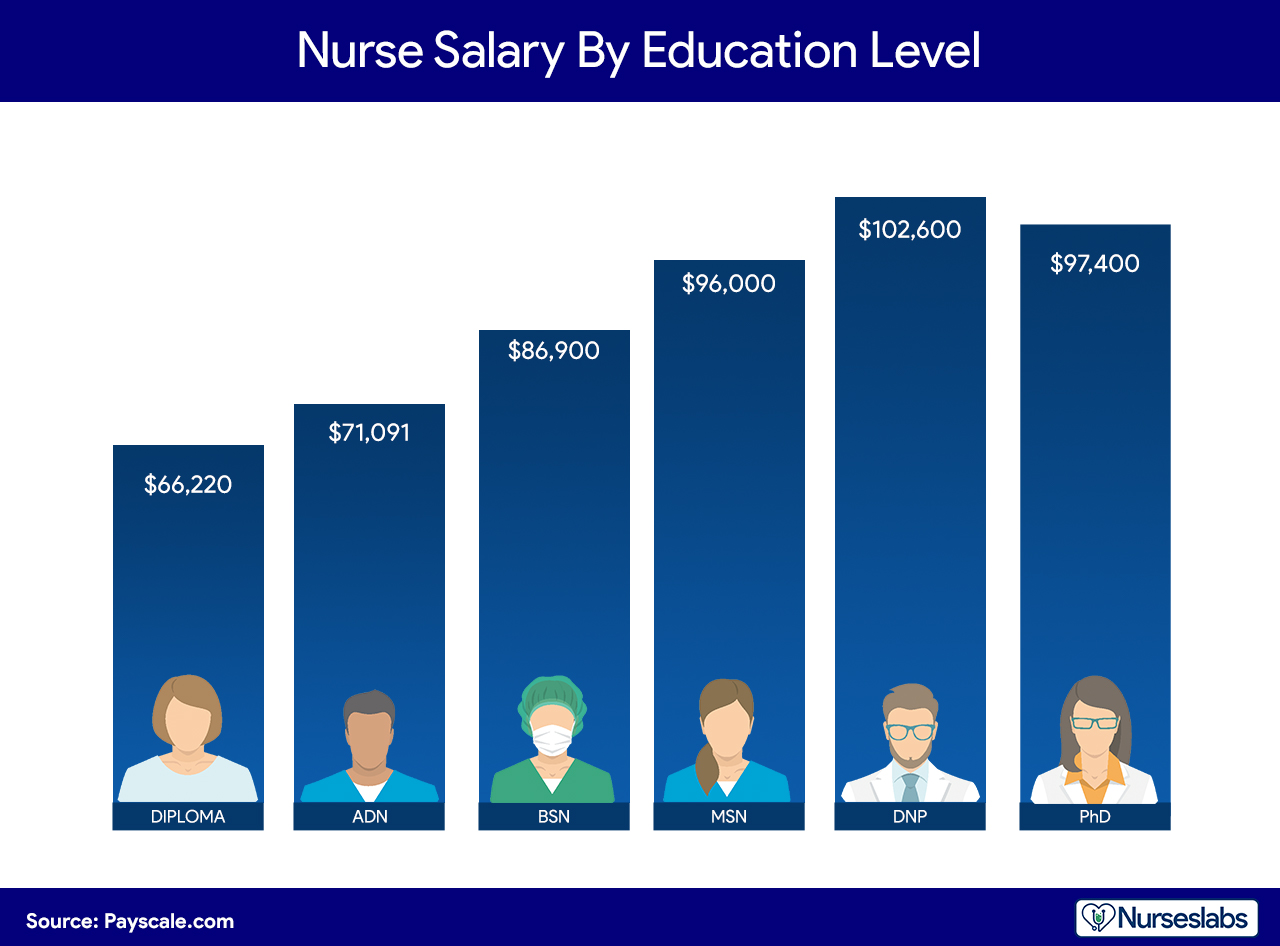
There is a significant time and cost difference between qualifying as a registered nurse with a two-year ADN and a four-year BSN. You may ask yourself whether the difference is worth it in terms of potential income. Some employers might start newly qualified registered nurses on the same salary but, as seen in the table above, those with higher qualifications earn more on average.
Another factor to consider is that nurses with a BSN have far greater opportunities for employment in the job of their choice and for career advancement. BSN nurses can be promoted to managerial positions such as that of a clinical nurse manager or a nursing director. They can also opt to study at the post-graduate level to become an Advanced Practice Registered Nurse (APRN) specializing in a field of nursing that interests them – and earning the salary that goes with the role. There is wide support in the US that all nurses should hold a BSN and a number of hospitals now employ only nurses qualified with a BSN.
Experience
Obviously, a newly qualified registered nurse will likely earn quite a bit less than the average registered nurse salary, which includes those with many years of experience. As you gain experience your salary will increase and you can also apply for another position that pays more – especially once you've gained at least a few years of experience in a particular field of nursing where there is a demand. Here it is worth mentioning that should you be interested in doing some travel nursing, most positions require 2-3 years of experience in a particular field like ICU.
Travel nurses help to meet staffing needs in hospitals and other facilities, usually for two to three months. In many cases, travel nurse salaries are higher than the pay for full-time permanent staff, from $50 an hour or more in specialty positions. An added benefit is that free, furnished, housing is usually included in the package.
Male vs Female: Gender Pay Gap in Nursing
The gender pay gap occurs even in nursing where females dominate the industry and only 12% of the nursing workforce is male. The 2020 Nursing Salary Research Report by Nurse.com found that average male nurse salaries in the sample was $80,000 compared to an average of $72,703 for women – a difference of more than $7,200 per year.

While men reported working slightly longer hours than women, this was not enough to explain the gender pay gap. One aspect that could contribute to men's higher salaries is that men are more likely to negotiate their salaries: 57% of men "most of the time or always" negotiate, while only 34% of women do so.
Nursing: Still a Great Career Choice in the US
The average registered nurse salary is higher than the average national wage in the US and unemployment is low at 1.2%. Furthermore, the BLS predicts that the number of jobs for registered nurses will grow by 12% up to 2028 – considerably more than most other jobs. There are also lots of opportunities for nurses to increase their income through specialization or promotion.
Besides, the job of nurse practitioner ranked #3 in the US top 100 jobs for 2021, while registered nurse came in at #37. This ranking considers not only salary and job opportunities, but also factors like job satisfaction, the potential for advancement, stress levels, and work-life balance.
References
- Occupational Employment and Wages, May 2020 – Registered Nurses (bls.gov)
- Registered Nurses – Occupational Outlook Handbook (bls.gov)
- Occupational Employment and Wages, May 2020 – Nurse Practitioners (bls.gov)
- Occupational Employment and Wages, May 2020 – Nurse Midwives (bls.gov)
How Much Money Does An Rn Make Per Year
Source: https://nurseslabs.com/nurse-salary/
Posted by: greertheationd81.blogspot.com
0 Response to "How Much Money Does An Rn Make Per Year"
Post a Comment